Job 19:4 (New Living Translation)
Even if I have sinned,
that is my concern, not yours.
This is Job talking a long time ago in a place far, far away. Suppose a Christian near me said this. Would I agree with him?
- Yes: It is none of my business how he lives.
- No: He is a brother who could fall away from Christ.
- Yes: If he is a Christian, he will be forgiven for his sin as we all are.
- No: I don’t like it when my brother sins as his sin can harm other people.
- Yes: If my brother’s sin doesn’t hurt me, what business is it of mine?
- No: It is a lot of my business as I care about the others who are hurt?
I could go on with this for a long time. Every answer that comes to mind brings an opposite answer. Let’s stop here.
I prefer that my brother not sin. I prefer that I not sin. Since both of us are human and sinful, my preferences won’t come true and I will have to learn how to live with our condition.
Tags: Job · Old Testament
1 Corinthians 9:16 (New Living Translation)
Yet preaching the Good News is not something I can boast about. I am compelled by God to do it. How terrible for me if I didn’t preach the Good News!
Paul is writing about preaching and being paid and other forms of compensation for preaching. Paul concludes that he is compelled to preach.
My father, a preacher, told the story about how when he was in preacher college a teacher told the class, “don’t preach if you can keep from it.” In other words, “You shouldn’t preach unless you absolutely can’t resist the compulsion to do so.”
This is what Paul is writing here. He must preach. He is compelled to do it; he can’t keep from it.
I suspect that the preacher-college teacher who taught my father new of this fellow Paul.
Tags: 1 Corinthians · New Testament
Isaiah 53:3 (New Living Translation)
He was despised and rejected—
a man of sorrows, acquainted with deepest grief.
We turned our backs on him and looked the other way.
He was despised, and we did not care.
This is a prophecy from Isaiah. The “He” discussed is Jesus (some believe otherwise, but I read this as Jesus).
Jesus suffered, and we did not care. The “we” here are the Jews, but again, others disagree on that. I could extend the “we” to all Jews and Gentiles alive at the time and in the area of Judea. There were crowds of people about Jesus at various times in his ministry. He was well known as He performed miracles.
Then came the crucifixion. Nothing better to cause people to find something else to do than a good old, slow, excruciating public execution. I think that is what happened. The miracles ceased, Jesus was arrested, and things went down hill.
Perhaps Jesus was a phony. Perhaps those miracles were tricks, slight of hand. I mean, from a human perspective, if Jesus could really do those things, He could have easily avoided a public execution. The execution proved He wasn’t what He seemed.
Wrong.
Funny how we haven’t changed much, people that is. We go along when things are good, and lose interest when things turn mediocre or worse. Excitement quickly turns to don’t care.
Tags: Isaiah · Old Testament
1 Corinthians 3:10-11 (New Living Translation)
10 Because of God’s grace to me, I have laid the foundation like an expert builder. Now others are building on it. But whoever is building on this foundation must be very careful. 11 For no one can lay any foundation other than the one we already have—Jesus Christ.
Paul writes a letter to the Church in Corinth. They had a few problems, well no duh, they had people there so they had a few problems. Most of their problems seem to stem from human pride, no duh, they had people there. I can just hear the people:
Person #1: I was at a meeting where this man who knew Paul personally talked about what Paul said.
Person #2: Oh yeah, you think that is something. I was at a meeting where Paul himself spoke. (Hint, I am better than you.)
Person #3: Oh yeah, I shook hands with a person who shook hands with Jesus. (Hint, I am better than you.)
There was all this I’m-better-than-you talk. There was all this I-follow-what’s-his-name talk.
Paul answers all this talk with something simple:
The foundation is Jesus.
Today? We have all this talk continuing about who knew whom and where they went to school and how much money they have and all that other stuff. Return to the simple:
The foundation is Jesus.
If people are concentrating on something else, move on.
Tags: 1 Corinthians · New Testament
Job 6:6 (New Living Translation)
Don’t people complain about unsalted food?
Does anyone want the tasteless white of an egg?
This is Job talking. He is attempting to justify his complaining to God about his circumstances. Please note, Job is in some bad circumstances.
And then Job throws in this phrase:
Does anyone want the tasteless white of an egg?
What? I guess in the day of Job they didn’t have the controversy about which part of the egg is bad for your heart.
Tags: Job · Old Testament
Luke 24:13-17 (New Living Translation)
13 That same day two of Jesus’ followers were walking to the village of Emmaus, seven miles from Jerusalem. 14 As they walked along they were talking about everything that had happened. 15 As they talked and discussed these things, Jesus himself suddenly came and began walking with them. 16 But God kept them from recognizing him.
17 He asked them, “What are you discussing so intently as you walk along?”
They stopped short, sadness written across their faces.
On the day of his resurrection, Jesus joins two of His followers as they walk from Jerusalem to Emmaus. These two followers had sadness written across their faces.
How do you relate to people who are sad and discouraged? Jesus began walking with them. To walk with someone, you must do at least the following:
- Be next to the other person
- Face the same direction as the other person
Neither is a traditional teacher-to-student position. Neither is a traditional master-t0-underling position. Neither is typical of a I have something you need position.
God, help me to follow this example of Jesus as he walks with his followers.
Tags: Luke · New Testament
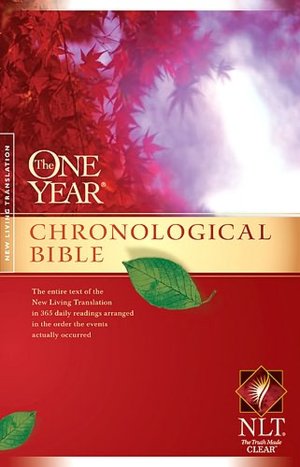
A little change in my Bible reading this year. I continue to read a One Year Chronological Bible, but this year in the New Living Translation.
Tags: Uncategorized
In the past, I have used the New International Version and the NIV 2011 in the vast majority of these blog posts. Starting now, I plan to use the New Living Translation (NLT) the vast majority of the time.
Why the change?
I recently learned that the NLT has surpassed the NIV as the most popular English translation of the Bible. The NIV was more popular for about 20 years, but the NLT has taken that spot for several years (a trend, not a blip). The NIV pew Bibles will be replaced by NLT pew Bibles in churches in the English-speaking world in the next few years. This is a repeat of the change from the King James Version pew Bibles to the NIV about 20 years ago.
Another reason for the change is that I am due for one. A few different words here and there might spur new contemplations.
Tags: Uncategorized
Exodus 23:14 (New Living Translation)
“Each year you must celebrate three festivals in my honor…”
Consider this one: God commanded His people to celebrate three festivals each year. Imagine that, being commanded to celebrate three times a year. And these were big celebrations, not a little birthday party for a child. Some of these celebrations lasted a week.
Today?
We celebrate Christmas. Some Christians see this as the true coming of Jesus to the world. Other Christians don’t see any inference in the New Testament and celebrate Christmas as a cultural holiday.
We celebrate Easter as the resurrection of Jesus. Again, like Christmas, some Christians don’t celebrate a single day for this.
I have often heard that every first day of the week is a celebration of the resurrection of Jesus.
I have often heard that every day is a celebration of the grace that God has extended to us.
Every day is a spiritual celebration of our life in Christ.
Today? Each of the above answers has merit and each has flaws. I don’t have an answer.
Tags: Exodus · Old Testament
Proverbs 15:27 (New Living Translation)
Greed brings grief to the whole family,
but those who hate bribes will live.
These Proverbs were written several thousand years ago or last weekend. Sometimes I confuse the two time periods. This proverb tells me that greed can ruin a family or a community or a nation. How did the proverb writer know about what would happen in America in the early 21st century?
Wall Street, Washington, Hollywood – those places are symbols of finance, politics, and entertainment. There are fine people in these sectors. There are, however, also lots of greedy people in those sectors.
It is a shame that we can’t take all the greedy people and place them in a corner so they can continue in their greed and not hurt the rest of us. Maybe the desire for the freedom from the acts of greed is greedy.
Tags: Old Testament · Proverbs